Sounds counterintuitive?
For the past two years, much of the conversation around AI memory has focused on one goal: helping models remember more.
Longer context windows. Better retrieval-augmented generation. Vector databases. Persistent memory. Larger knowledge stores.
The assumption has been fairly simple: if AI can retain more information, it will become more useful.
But enterprise AI introduces a different problem.
Remembering everything can be dangerous.
An old policy can remain in context long after it has been replaced. Outdated customer information can keep resurfacing. A decision made six months ago can be treated as current truth. A temporary exception can slowly become part of an agent’s perceived operating model.
And sensitive information can remain available much longer than it should.
In other words, the enterprise memory problem is not simply about storage capacity.
The real question is:
What should an AI system remember, what should it forget, and who gets to decide?
Memory is becoming infrastructure
A number of different approaches are already emerging.
Some treat memory almost like software.
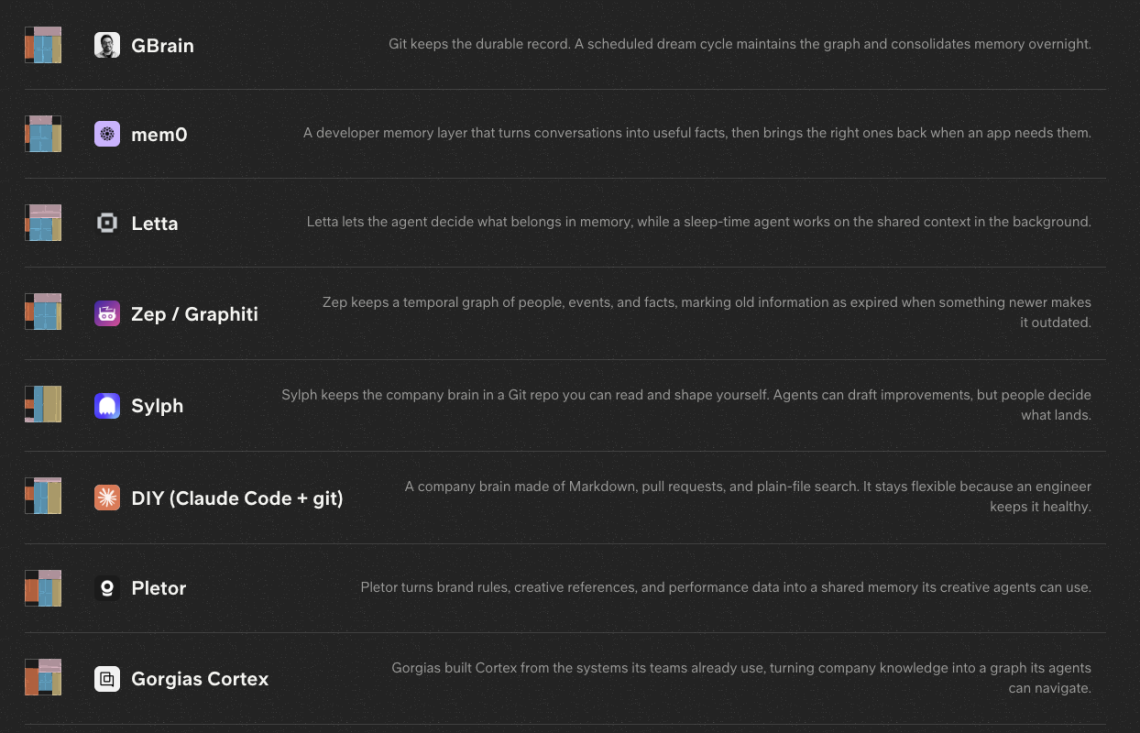
Projects such as GBrain, as well as internal systems like Gorgias Cortex, organize knowledge into structured files with version history, automated maintenance, and review processes. When something changes, the update can be handled almost like a code change: proposed, reviewed, and eventually merged.
This model has an interesting advantage. Instead of treating organizational knowledge as an invisible layer hidden inside a model, memory becomes inspectable and versioned.
Another approach is the explicit memory store.
Tools such as mem0 provide developers with a separate memory layer that applications can write to and retrieve from. Rather than assuming every interaction should become permanent memory, the application can decide which information deserves to persist.
There is also a more autonomous approach: agent-managed memory.
Frameworks such as Letta explore systems where agents themselves determine what information is worth retaining. Memory can then be reorganized, summarized, or maintained by additional processes over time.
That starts to move memory away from simple storage and toward something closer to active knowledge management.
But facts have a timeline
One of the biggest weaknesses of traditional retrieval systems is that they often treat information as static.
Enterprise knowledge rarely works that way.
Imagine an AI system learns:
Sarah owns Project X.
Three months later, responsibility changes:
David owns Project X.
A simple knowledge system may overwrite the first fact with the second.
But sometimes you need both.
You may want to ask:
Who owns Project X today?
But you may also want to ask:
Who owned Project X when this decision was made last March?
This is where temporal knowledge graphs, such as approaches being explored by Zep and Graphiti, become particularly interesting.
Instead of treating knowledge as a collection of timeless facts, the system can maintain relationships between facts and the periods during which they were valid.
The difference sounds small, but it becomes extremely important inside organizations.
Enterprise knowledge is constantly changing.
People change roles. Customers change requirements. Policies change. Projects change owners. Contracts expire. Exceptions are introduced and later removed.
A useful memory system needs to understand not only what is true, but also when it was true.
Human governance may matter even more
Another pattern is emerging alongside automated memory systems: human-governed memory.
Systems such as Pleto, Gorgias Cortex, and Slite Agent reflect variations of this idea.
AI can identify potentially outdated information. It can detect contradictions, propose updates, or surface knowledge that may need attention.
But humans remain responsible for changing the canonical source of truth.
That distinction could become extremely important for enterprise AI.
An AI agent should probably be able to say:
“I believe this information may be outdated.”
That does not necessarily mean it should be allowed to rewrite the organization’s official knowledge base.
Memory systems may therefore need a governance model similar to software development: agents can propose changes, while authorized humans approve them.
Enterprise memory is a state-management problem
This is why I increasingly think enterprise memory should be viewed as a state-management problem, not just a retrieval problem.
A mature memory layer needs to understand:
- what happened
- what is currently true
- what used to be true
- where the information came from
- who said it
- who is allowed to see it
- how confident the system should be in it
- when the information should expire
- who is allowed to modify the source of truth
That is a very different challenge from simply retrieving the five most similar chunks from a vector database.
A vector database alone does not solve it.
A larger context window does not solve it.
And putting every Slack message, meeting transcript, email, document, and CRM record into a model certainly does not solve it.
In fact, doing that may make the problem worse.
The more information an AI system can access, the more important it becomes to understand the lifecycle of that information.
From knowledge retrieval to organizational memory
The architecture of enterprise memory may therefore start looking less like a single database and more like a system:
Sources → Extraction → Memory → Relationships → Time → Permissions → Retrieval → Feedback → Human Governance
Each layer answers a different question.
Where did this information come from?
What should be remembered?
How does it relate to other information?
Is it still valid?
Who should be able to access it?
Did the agent use it correctly?
Should the memory be updated—or removed?
Over time, this starts to resemble something closer to an organizational brain than a traditional knowledge base.
And that may be one of the most important infrastructure shifts as enterprises move from AI assistants that answer questions to AI agents that continuously operate inside business workflows.
The hardest question may no longer be:
How do we make AI remember everything?
It may be:
How do we teach AI what is worth remembering—and when to forget?